What Is Sublimation Printing? What It Can (and Can’t) Do
A plain-English guide to sublimation printing: how the dye bonds, which materials work (and which never will), why white blanks look brightest and where we use it in Houston.
Sublimation printing uses heat to turn special dye into a gas that bonds with polyester fibers or with a coating on a hard surface. The design becomes part of the item instead of sitting on top of it, so on fabric you cannot feel it and it does not crack or peel. It only works on the right materials: white or light polyester, and items made or coated for sublimation.
This guide explains how sublimation works, what it can and cannot print on, how to prepare artwork so the colors come out right, and where we use it at VS Print Studio in Houston. If you are choosing between methods, our comparison of DTF, sublimation and screen printing puts them side by side.
How does sublimation printing work?
There are four steps:
- The design is printed on transfer paper. A printer with sublimation ink prints the artwork in mirror image. On the paper the colors look dull; they come alive after the heat.
- The paper is placed on the item. It goes onto a polyester shirt or pillow cover, around a coated mug or tumbler, or onto a keychain blank.
- Heat and pressure are applied. The dye turns from a solid into a gas without passing through a liquid stage. The gas enters the polyester fibers, or the polymer coating on a hard item.
- The item cools and the dye locks in. The paper is peeled off, and the design is now part of the surface.
The word sublimation comes from that solid-to-gas step. Because the dye ends up inside the material instead of on top, there is no layer of ink to feel, crack or peel.
What does sublimation do well, and what can’t it do?
What it does well:
- No feel. On fabric, the shirt feels like the plain shirt, because the dye is inside the fibers.
- No cracking or peeling. There is no film or ink layer to lift.
- Photos and gradients. Full color with photographic detail.
- Color from edge to edge on coated items, across the whole wrap area.
Its limits:
- Only polyester or coated surfaces. Anything else will not hold the dye.
- No white dye, so it does not work on dark fabric.
- Small color shifts between your screen and the finished piece.
- The item’s own color counts, because the dye is transparent.
What can you sublimate on, and what can’t you?
The material decides everything, so check it before you design.
| Material | Does it work? | Why |
|---|---|---|
| White polyester shirt | Yes, the best result | Polyester fibers take the dye, and white gives the brightest colors |
| Light-colored polyester | Yes, with color shifts | The dye is transparent, so it mixes with the shirt color underneath |
| Dark polyester | No | There is no white dye, so the design barely shows |
| 100% cotton | No | The dye has nothing to bond with and washes out |
| Cotton-polyester blends | Weak | Only the polyester fibers take the dye, so colors look muted |
| White coated stainless tumblers and mugs | Yes | The coating is made to accept the dye |
| Sublimation-ready ceramic mugs | Yes | Same idea: the dye bonds with the coating |
| Glossy-coated MDF keychains, photo frames, polyester pillow covers | Yes | These blanks are made for sublimation |
| Raw metal, glass, wood or plastic without a coating | No | There is no surface for the dye to bond with |
Why do sublimation colors look brightest on white?
Sublimation dye is transparent. There is no white dye, so the color you see is the dye plus whatever color the item already is. On a white blank the colors show true. On a light blue shirt, yellow turns greenish. On a dark shirt, the design all but disappears.
The same logic explains white areas. In a sublimation design, white is not printed: it is the bare blank showing through. A white shirt gives you white, and a light gray shirt gives you light gray.
Why are mugs and tumblers such a good fit?
Mugs and tumblers are where sublimation does its best work, for four reasons:
- The coating is made for it, so the color comes out bright and permanent.
- The design wraps around the piece: from 8.5 x 3.5 in on the 11 oz mug to 10.5 x 7.5 in on the 40 oz tumbler.
- Photos print sharply.
- There is no vinyl edge to catch a fingernail or lift in the wash.
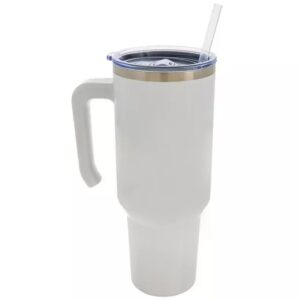
Our tumbler and mug size guide lists every wrap size. The 11 oz ceramic mug and the 40 oz white stainless tumbler for sublimation are made for this. For names and simple logos, vinyl can be the better choice, and sublimation vs vinyl on tumblers helps you decide.
How does sublimation compare with DTF and vinyl?
| Method | Works on | Dark garments | Photos | Feel | Best for |
|---|---|---|---|---|---|
| Sublimation | White or light polyester, coated items | No | Yes | None | Gifts, drinkware, white polyester |
| DTF | Cotton, polyester and blends, light or dark | Yes | Yes | Thin, flexible layer | Most shirts, one-offs |
| Heat-transfer vinyl | Most fabrics and some hard surfaces | Yes | No, solid colors only | Smooth vinyl layer | Names, numbers, simple logos |
Decide by surface first. Polyester or a coated item makes sublimation an option, cotton or a dark color points to DTF, and names and numbers point to vinyl. Read what DTF printing is to see the other side.
When does sublimation make sense?
Sublimation is usually the right call when:
- You are decorating a mug, tumbler, keychain, photo frame or pillow cover made for it.
- The design is a photo, or has gradients and many colors, and you want it edge to edge.
- You want a white or light polyester shirt with a print you cannot feel, for a run, a school field day or an event.
- You want the color to be part of the item and not a layer on top.
It is usually not the best call when:
- The shirt is cotton or dark: DTF fits better.
- You need simple names and numbers in one color: vinyl is enough.
- You need hundreds of identical cotton shirts: screen printing is more practical.
How should you prepare artwork for sublimation?
You never need to mirror or resize anything: we prepare the print-ready file. If you prefer to send a file, keep these points in mind:
- Cover the whole print area. Extend backgrounds to the edges of the wrap so no thin white line shows, and keep text and faces inside the safe area.
- Use the right canvas. At 300 DPI, an 11 oz mug is 2550 x 1050 px, a 20 oz tumbler is 2790 x 2400 px, a 30 oz tumbler is 3000 x 2250 px and a 40 oz tumbler is 3150 x 2250 px. 150 DPI is the minimum.
- Expect small color shifts. A screen glows and dye inside a surface does not, so the result is close but not identical. Strong, saturated colors work well, while neon, fluorescent and metallic effects are hard to reproduce.
- Plan for white. White areas are the color of the blank.
- Send the best file you have.
.pngwith a transparent background is recommended, vector files are ideal for logos, and screenshots and heavily compressed images should be avoided.
The print-ready artwork checklist covers the rest, and what DPI you need for printing explains resolution with examples.
Mistakes to avoid
- Assuming any white shirt works. A white cotton shirt still will not hold the dye. It has to be polyester.
- Expecting full color on a colored item. The dye is transparent, so the item’s color changes the result.
- Designing white text for a colored item. White is not printed, so it only reads on a white blank.
- Leaving the background short of the edges. A thin white line can show at the edge or at the seam.
- Starting from a low-resolution logo. A logo that is 500 px wide and stretched across a 9 in wrap will look blurry.
How do you care for sublimated items?
- Shirts: turn them inside out, wash cold on a gentle cycle and avoid ironing directly over the print.
- Stainless tumblers and mugs: hand wash, and no microwave.
- Ceramic mugs: most are microwave and dishwasher safe, and each product page says so.
The details are in our care guide for sublimated tumblers and mugs and, for shirts, in how to wash custom printed shirts.
Where we use sublimation at VS Print Studio
We use sublimation where the surface is right: white polyester tees, 11 oz mugs, white stainless tumblers, MDF keychains, photo frames and pillow covers. Cotton and dark garments go to DTF, and names and numbers can go to vinyl. Tell us what you want to make and send a finished design, an idea or only a description. We prepare the print-ready file, show a mockup and print nothing until you approve it.
Most standard orders are ready in 2-5 business days after you approve the design. Larger or more complex orders may need more time, and the quote confirms the date. You can pick up in Houston or have it shipped across the U.S., and we answer in English or Spanish. Browse custom tumblers and mugs, personalized gifts or custom t-shirts, or take a look at the 18x18 sublimation pillow.
Quick checklist: is sublimation right for your project?
- The item is white or light polyester, or it is made or coated for sublimation
- My design uses full color or a photo
- I am fine with the item’s own color showing wherever the design has white
- My image is large enough for the print area, or I will send the original file
- I know the care: hand wash for stainless drinkware, cold and inside out for shirts
- I know the quantity and the date I need it
Products mentioned in this guide
-
Men
JenPen Unisex Sublimation Shirt – White Polyester T-Shirt for Custom Printing
$17.99 Select options This product has multiple variants. The options may be chosen on the product page



Frequently asked questions
What is sublimation printing in simple terms?
Sublimation printing uses heat to turn special dye into a gas that soaks into polyester fibers or a coating on a hard item. When it cools, the color is locked inside the surface. That is why a sublimated shirt feels like a plain shirt and the design does not crack or peel.
Can sublimation work on cotton or dark shirts?
Not well. The dye only bonds with polyester or a special coating, so on cotton it washes out. It is also transparent and there is no white dye, so on a dark shirt the design barely shows. For cotton or dark garments, DTF is the better method.
Is sublimation printing permanent?
On the right surface, yes: the color is inside the polyester or the coating, so there is no layer to peel or crack. Care still matters. Wash shirts inside out in cold water, hand wash stainless drinkware and avoid abrasive scrubbing. We do not quote lifespans because they depend on use and care.
What items can be sublimated?
White or light polyester shirts, and items made or coated for sublimation: ceramic mugs, white stainless tumblers, MDF keychains, photo frames and polyester pillow covers. Raw metal, glass, wood or plastic without a coating will not take the dye, and cotton or dark fabric is not a good fit.
What is the difference between sublimation and DTF?
Sublimation turns dye into gas that bonds inside polyester or a coating, so it works only on those surfaces and leaves no feel. DTF prints on a film and transfers it with powder and heat, so it works on cotton, polyester and blends, including dark colors, with a thin layer on top.
Why do sublimation colors look different from my screen?
A screen glows with light, while sublimation dye sits inside the material, so the result is close but rarely identical. The dye is also transparent, so the color of the item changes the result. Strong, saturated colors work well, while neon and metallic effects are hard to reproduce.

Practical guides from our studio in Houston, Texas. We prepare your print-ready file, show you a mockup and print nothing until you approve it. Questions? Message us in English or Spanish. About us
More guides for you
Best Way to Print on Dark Shirts (and Why Sublimation Won’t Work)
Why dark garments are harder to print, which methods work, which colors read best and how to prepare artwork so your logo or photo looks right on black, navy or charcoal.
What Is DTF Printing? How It Works, Pros, Cons and Best Uses
A plain-English explanation of DTF printing: the steps, what it does well, where it is weaker, how it compares with other methods and when we choose it for Houston orders.
DTF vs Sublimation vs Screen Printing: Which Is Right for Your Order?
A plain-English comparison of the five ways custom apparel and gifts get decorated, with a decision table, honest limits and the rule we use to quote Houston orders.
Tell us your idea — we make it real
Send your design, your idea or just a description. We prepare the file at the right size and personalize it for you — in English or Spanish, by message or on WhatsApp.