Embroidery vs Printing for Hats, Polos and Uniforms
Stitched thread or a DTF and vinyl print? A plain-English comparison for caps, polos and uniforms, with a decision table by item and tips to get your logo ready.
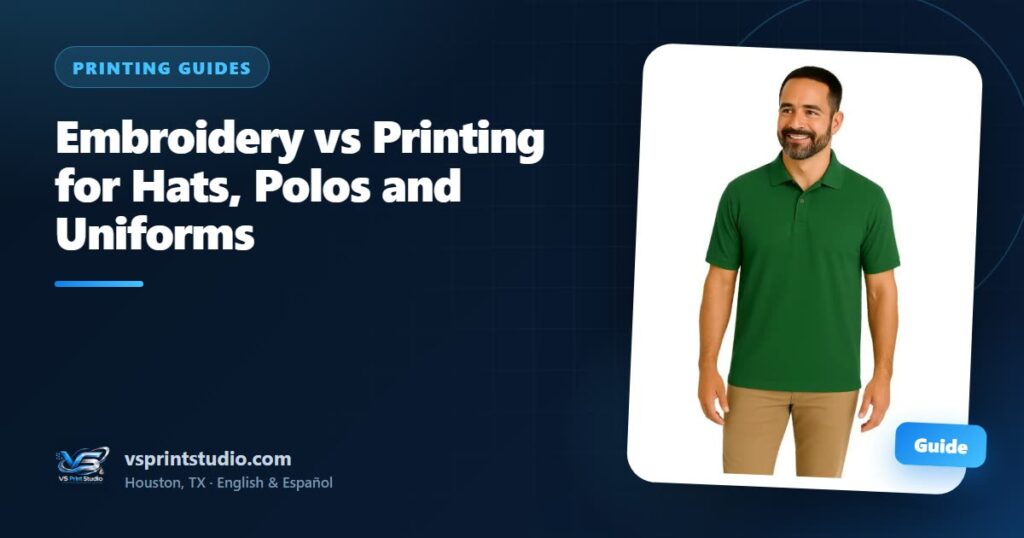
The short answer: choose embroidery for caps and polos when your logo is bold and simple, because stitches give a premium look and stand up to heavy use. Choose printing (DTF or vinyl) when the design has fine detail, tiny text, gradients, photos or many colors.
At VS Print Studio in Houston we offer embroidery for hats and polos, and print for almost everything else. This guide compares the two in plain terms, with a decision table by item, tips for getting a logo ready to stitch and an honest list of what each method cannot do.
What is embroidery, and how is it different from printing?
Printing puts color on the surface of the garment: DTF as a thin film, vinyl as a cut sheet. Embroidery puts no ink on anything. A machine sews the design with thread, stitch by stitch, through the fabric, with a backing underneath that keeps the fabric flat.
Before the machine can sew anything, the artwork has to be converted into stitch instructions: where every stitch goes, in which direction and in what order. This step is called digitizing, and it is the reason embroidery prefers simple logos. A stitch file, once made, can normally be reused for later orders of the same logo.
Three things shape the result: the size of the design, how many stitches it needs and how many thread colors it uses. More stitches mean more machine time, a heavier feel and a greater chance of puckering on a light fabric.
Embroidery vs print at a glance
| Feature | Embroidery | Print (DTF or vinyl) |
|---|---|---|
| Look | Raised stitches with texture; a premium finish | Flat and smooth; DTF in full color, vinyl in solid color |
| Fine detail and tiny text | Limited | Strong with DTF |
| Gradients and photos | Not suited | Yes with DTF |
| Colors | A fixed palette of thread colors; fewer work best | Unlimited with DTF; solid colors with vinyl |
| Dark items | Thread is opaque, so light colors stay bright | DTF adds a white layer; vinyl is opaque |
| Feel | Raised stitches with a backing inside | A thin film (DTF) or a vinyl layer |
| Durability | Very good under heavy use and frequent washing | Good with gentle care; heat is its enemy |
| Best on | Caps, polos and other structured items | T-shirts, hoodies and detailed artwork |
Which one for which item?
| Item | Better choice | Why |
|---|---|---|
| Structured cap, front panel | Embroidery | Stiff, curved caps are awkward to print on, and stitches hold up to sweat and handling |
| Polo, left-chest logo | Embroidery for bold logos, print for fine detail | Stitching is the classic uniform look; a piqué knit has a textured surface that can soften small print details |
| T-shirt, such as our Gildan G500 | Print (DTF or vinyl) | Light and flexible, and large designs stay comfortable |
| Hoodie or sweatshirt | Big designs go on easily; embroidery on a hoodie is a separate request, so ask first | |
| Jacket | Ask us first | Small logos on structured fabric suit stitching, but we confirm what we can do on each jacket |
| Bag | Ask us first | It depends on the bag and its material |
Why are caps usually embroidered?
Structured caps have a stiff front panel, a curved crown and seams. A heat press wants a flat, even surface, so printing on a cap is awkward. Embroidery stitches through the panel, follows the shape and holds up to sweat, sun and rough handling.
The front panel is the main stage, and it is a wide, fairly short rectangle. Wide, low logos fit best, while tall stacked logos have to shrink to fit. Some designs also use the side or the back of the cap for a small mark such as a website or a year. Tell us if you want that and we confirm what is possible.
To keep a cap’s shape, spot clean it or hand wash it and let it air dry, because a dryer can warp a brim. You can see what we offer for headwear on our custom hats and caps page.
Polos: embroidery or print?
The left-chest logo is where embroidery shines on a polo. It reads as a uniform, stays crisp through frequent washing, and a small stitched mark is barely noticeable from the inside. A left-chest print on our shirts is 3.5 to 4 in wide (3.5 in for S and M, 4 in for L to 3XL), and a stitched logo usually lands in the same range. We confirm the exact size for your item.
Print is the better choice when the logo has a gradient, small text or many colors. A piqué knit has a textured surface, so very fine details can look softer than they do on a smooth tee. A big embroidered design on a thin knit can also pucker or feel stiff, so for a large design across the chest or back, printing is the better call.
Our piqué polo is a natural fit for embroidery. If your logo is too detailed to stitch, tell us and we suggest the best way to handle it. For a whole crew, our guide to an employee uniform program covers sizes, reorders and logo placement.
How do you get a logo ready for embroidery?
A logo that looks great on screen does not always stitch well. These rules of thumb help, and we check each design when we digitize it.
- Bold shapes. Hairlines and very thin strokes disappear or look uneven in thread.
- Readable text. As a general rule, letters shorter than about a quarter inch (6 mm) do not stitch cleanly. Make them bigger or leave them out.
- Few colors. Every color change is another thread, so simpler logos look cleaner and sew faster.
- Flat color. Thread cannot blend shades, so gradients, shadows and glows turn into flat bands or get dropped.
- A good file. Send the best version you have. A vector file (
.svg,.ai,.epsor a vector PDF) is ideal, and a large.pngworks too. Our guide to making your logo print-ready shows how to find the right file.
Thread colors vs ink colors
Printed colors come from your file, so a brand color can be matched closely in a print. Thread comes in a fixed palette, so we choose the closest thread for each color in your logo. It is usually very near, but it will not always be identical to the color on your printed materials. If an exact match matters to you, say so when you ask for a quote.
On dark caps and polos, thread has an advantage. It is opaque, so a yellow or white logo stays bright without any under layer.
What drives the cost of embroidery and print?
Because custom work is quoted order by order, we do not post a price list. These are the factors behind the number:
- Stitch count and size. A big, dense design takes more machine time than a small left-chest mark.
- Digitizing. Converting a logo into a stitch file is a one-time step per design, so embroidery gets better value as the quantity grows.
- Print size and colors. For DTF the size of the artwork matters most, and for vinyl the number of colors does.
- The item. Caps, polos and T-shirts each have their own base cost.
- The file. A clean vector logo is quicker to prepare than a low-resolution image we have to rebuild.
For real numbers on your order, ask for a free quote and tell us the item, how many pieces and when you need them.
Mistakes to avoid
- Embroidering tiny text. Small letters fill in with thread and become unreadable. Print the small text, or make it bigger.
- Sending a photo to be stitched. Photos need print, not thread.
- Choosing embroidery for a huge design on a thin shirt. Heavy stitching can pucker light fabric. Print big designs.
- Expecting an exact brand-color match in thread. Tell us if exactness matters.
- Sending a screenshot as the logo. Low-resolution files are hard to convert. Send the original, or see the print-ready artwork checklist.
- Forgetting the size list. Polos come in different cuts and sizes, so collect sizes before you order.
How we can help
We offer embroidery for hats and polos, and print (DTF and vinyl) for T-shirts, hoodies and designs that are too detailed to stitch. Send your logo, or only an idea, and we build the stitch file or the print file, send you a mockup and make nothing until you say yes. After approval, most standard orders are ready in 2–5 business days; larger or more complex orders may need more time, and the quote confirms the date.
Ordering for a team or a business? See how bulk orders work, or compare every method side by side in DTF vs sublimation vs screen printing. Pickup is in Houston, we serve the area from Katy to Baytown, and orders ship anywhere in the U.S.
What to send us
- The item: cap or polo, the style and the color
- The quantity, and the sizes for polos
- Your logo file, or the best image you have
- Where the logo goes: cap front, left chest or another spot
- Any text, spelled exactly as it should appear
- Brand colors, if matching matters
- The date you need it
Products mentioned in this guide
-
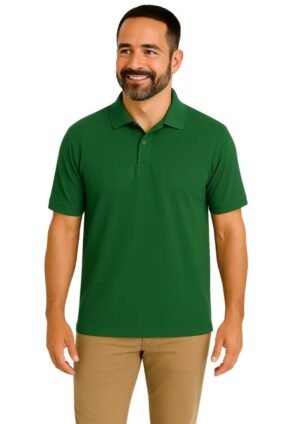
Polo Shirt
Piqué Classic Polo Shirt for Men – Casual and Formal Wear with Breathable Fabric
$26.99 Select options This product has multiple variants. The options may be chosen on the product page -
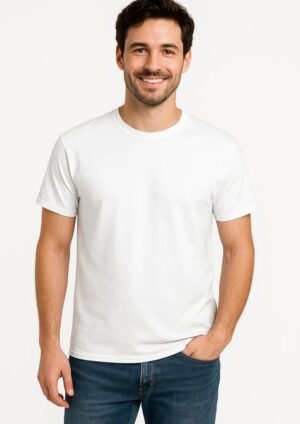
T-shirt
Gildan G500 Heavy Cotton™ 5.3 oz T-Shirt
$17.99 Select options This product has multiple variants. The options may be chosen on the product page
Frequently asked questions
Is embroidery better than printing on polos?
Not always. A bold, simple logo looks premium and holds up very well when it is stitched on a polo. A logo with a gradient, small text or many colors is usually better printed, because thread cannot blend shades or sew tiny letters cleanly. Send your logo and we recommend the better option for your design.
Why are caps usually embroidered instead of printed?
Structured caps have a stiff front panel, a curved crown and seams, which makes them awkward to print on. Embroidery stitches through the panel, follows the shape and handles sweat, sun and rough handling well. That is why stitched logos are the usual choice for hats.
How small can embroidered text be?
As a general rule, letters shorter than about a quarter inch (6 mm) do not stitch cleanly, and very thin lines can disappear. If your design has smaller text, we can enlarge it, simplify it or print it instead. We check every design when we prepare the stitch file.
Can you embroider a photo or a gradient?
Not well. Thread comes in a fixed set of colors and cannot blend smoothly, so photos and gradients turn into flat bands or lose detail. Printing with DTF is the better method for photos, gradients and designs with many colors.
Does embroidery last longer than a print?
Embroidery handles heavy use and frequent washing very well, because the design is stitched into the garment. A print can also last a long time when it is washed inside out in cold water and kept away from hot dryers and irons. Neither has a fixed number of washes.
Do I need a special file for embroidery?
No. Send the best version of your logo, ideally a vector file or a large PNG, and we prepare the stitch file. We show you a mockup first, and nothing is stitched until you approve it.
Practical guides from our studio in Houston, Texas. We prepare your print-ready file, show you a mockup and print nothing until you approve it. Questions? Message us in English or Spanish. About us
More guides for you
DTF vs Heat Transfer Vinyl (HTV): Which Should You Choose?
DTF prints full-color designs on film, while heat-transfer vinyl is cut from sheets of flat color. See where each one wins, with a decision table and a team-shirt example.
Best Way to Print on Dark Shirts (and Why Sublimation Won’t Work)
Why dark garments are harder to print, which methods work, which colors read best and how to prepare artwork so your logo or photo looks right on black, navy or charcoal.
What Is Sublimation Printing? What It Can (and Can’t) Do
A plain-English guide to sublimation printing: how the dye bonds, which materials work (and which never will), why white blanks look brightest and where we use it in Houston.
Tell us your idea — we make it real
Send your design, your idea or just a description. We prepare the file at the right size and personalize it for you — in English or Spanish, by message or on WhatsApp.