Employee Uniform Program Checklist for Small Businesses
A practical checklist for rolling out employee uniforms at a small Houston business: garments by job, logo placement, sizes, new hires, a rollout timeline and a one-page spec to send us.
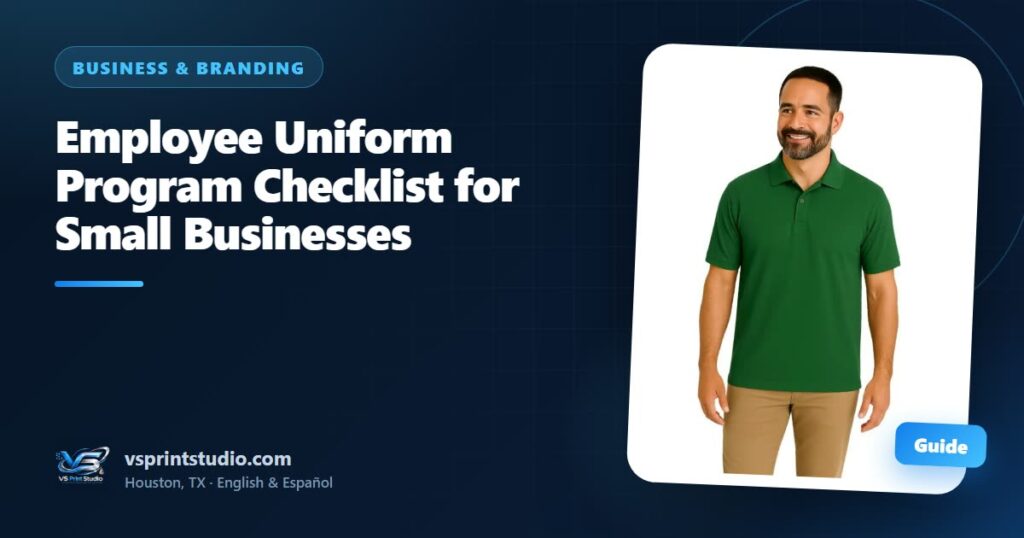
The short answer: a uniform program for a small business is a one-page plan, not a big project. Decide what the uniform is for, choose one garment for each kind of job, fix where the logo goes, work out how many pieces each person needs, keep one list of sizes, and plan the first reorder before the first order arrives. Do that and employee uniforms for a small business become an order you can repeat whenever someone new joins.
This is the checklist we use at VS Print Studio in Houston. It works for cleaning crews, restaurants, trucking companies, shops and offices. You will find a garment table, logo sizes, a rollout timeline, a care card for your team and a one-page spec you can copy and send us.
Start with the purpose: what is the uniform for?
Write the answer in one sentence before you look at a single shirt, because every other choice follows from it. Most small businesses want one or more of these three things:
- Identity. Customers and neighbors can tell who works for you. That needs a visible logo or name and the same color on everyone.
- Trust. A person at a front door, a front desk or a loading dock looks like part of a real business. That favors clean pieces that match and fit well.
- Visibility and safety. Some jobs and sites require specific high-visibility clothing. That rule comes from your client or the site, not from the print shop, so ask them before you choose anything. Our guide to construction crew uniforms lists the questions to ask.
A purpose line might read: “Customers should recognize our crew from the driveway, and the shirt has to survive weekly washing.” That one sentence settles many later arguments about color, fabric and size.
Which garment for which job?
Pick by the work, not by the catalog. Houston is hot and humid for much of the year, so comfort is the first test for anyone who works outside, in a van or on their feet. Cotton is soft and familiar but holds sweat, while polyester and 50/50 blends dry faster. Our guide to cotton vs polyester vs blends explains the trade-offs.
| Job | Good starting point | Why | Usual decoration |
|---|---|---|---|
| Office, front desk, supervisors | Piqué polo | A dressier look that reads as a uniform. Check the product page for its cut and sizes | Embroidered logo on the left chest |
| Crew working in the heat | Gildan G800 DryBlend 50/50 tee | A cotton and polyester blend that dries faster than cotton alone | DTF logo on the chest, name and phone on the back |
| Cool mornings, air-conditioned vans | Gildan G185 hoodie | The cool season is short and mild, so a mid-weight fleece is usually enough | DTF or vinyl: small chest logo, bigger back print |
| Anyone outdoors | Cap | Shade, and a second place for your logo | Embroidery; see custom hats and caps |
Colors, fiber content and size range change by model, so read the product page of each one. Not every model goes up to 3XL, and unisex, men’s and women’s cuts fit differently.
Choose the garment color with the logo in mind. A dark shirt hides stains and everyday dirt, and DTF keeps a light or colorful logo bright on it. A light shirt shows dirt sooner. Whatever you pick, use one color for the whole crew so the uniform looks like a uniform. Our guide to designing for dark and light garments shows what changes in the artwork.
Working in a specific trade? We wrote separate guides for cleaning businesses, trucking companies and restaurants and food trucks.
Where should the logo go on an employee uniform?
Three places do most of the work. These are the print widths we use on adult unisex shirts:
| Placement | Print width | What usually goes there |
|---|---|---|
| Left chest | 3.5 in on S and M, 4 in on L to 3XL | A small logo, sometimes with a first name |
| Back | 10.5 in on S, 11.5 in on M, 12 in on L, 12.5 in on XL, 13.5 in on 2XL, 14 in on 3XL | Business name and phone or website, or a larger logo |
| Sleeve | 3 in on S and M, 3.5 in on L to 3XL | A crew number, a year or a small mark |
Height follows the proportions of your artwork. Women’s cuts have their own smaller print areas, and we confirm the exact size for each item. You do not need a separate file for each size: send one logo and we prepare the print-ready file at the right size and canvas. Our T-shirt print size chart shows the width for every size from S to 3XL.
Give the back more thought than it usually gets. It is what people see when your staff walk away, bend over or leave a driveway. Put the business name and one way to reach you there, in big, simple letters, and check the phone number digit by digit.
Embroidery or print for employee uniforms?
Choose by garment and by logo.
- Embroidery suits polos and caps. Stitched thread looks premium and handles heavy use, and it works best with bold shapes, short text and a few colors.
- DTF is a full-color transfer that suits tees and hoodies. It handles fine detail, gradients and dark garments.
- Heat-transfer vinyl suits names, numbers and simple one-color designs.
If your logo has small text or a gradient, keep two versions: the full logo for printing and a simplified one for stitching. It is the same brand with two files. Our comparison of embroidery vs printing for hats and polos covers the limits of each, and DTF vs sublimation vs screen printing compares every method we use.
How many pieces does each person need, and how do you handle sizes?
Count the shifts between laundry days. Someone who works five days before washing needs five shirts, plus a spare for the day one gets stained. Part-timers need fewer. Treat hoodies and caps as extras, not as replacements for the daily shirt.
Then build one roster and keep it current. These columns are enough (the rows are an illustration, not real data):
| Name | Role | Cut | Size | Issued | Notes |
|---|---|---|---|---|---|
| Carlos | Field crew | Unisex | XL | 3 tees, 1 hoodie | Likes a loose fit |
| Ana | Office | Women’s | M | 2 polos | Prefers the women’s cut |
| Mateo | Field crew | Unisex | L | 3 tees | New hire, confirm size |
The cut column matters as much as the size, because unisex and women’s sizes fit differently. Ask new hires for their cut and size before their first day, and order in batches instead of one shirt at a time. A few spare shirts in your most common sizes cover the first days of a new person. Put the basics in writing too: what you provide, how many pieces, what happens when a piece is damaged and what happens when someone leaves. Who pays for uniforms can depend on your situation, so ask your accountant or an employment professional about that part.
When you reorder, send the mockup you approved last time. Blank shirts can change or run out, so we confirm that the same model and color are still available. Our guide to how many of each size to order goes deeper.
Keep your logo files and colors consistent
A uniform looks mismatched when the logo shifts between orders. Keep one folder and use it every time:
- The logo as a vector file (
.svg,.ai,.epsor a vector.pdf) and as a large.pngwith a transparent background. - A light version for dark garments and a dark version for light ones.
- A simplified version for stitching.
- Your brand colors, as color codes if you have them, plus the exact text: business name, phone number and website.
Only have a low-resolution image? Send it with a note and we tell you what can be done. Our print-ready artwork checklist shows what makes a file easy to work with. Colors on a screen and in print never match perfectly, so tell us if an exact match matters.
How do you roll out employee uniforms for a small business?
Work backward from the day people start wearing them. The timing we can state up front is this: most standard orders are ready in 2–5 business days after you approve the design. Larger or more complex orders may need more time, and the quote confirms the date.
| Phase | What happens | Who |
|---|---|---|
| 1. Decide | Purpose, garments and logo placement | You |
| 2. Collect | Roster with cut and size for everyone, plus logo files | You |
| 3. Quote | You send the spec; we confirm the method, the quantity and the date | You and the studio |
| 4. Approve | We prepare the files and send a mockup; one person checks it and says yes | You |
| 5. Production | We print or stitch only after you approve the mockup | The studio |
| 6. Pickup or shipping | Pick up in Houston or ship across the U.S.; shipping adds carrier time | You |
| 7. Handout | Check each person’s size, hand out the care card, update the roster | You |
If the start date is close, message us on WhatsApp before you collect sizes. Selected items may qualify for rush production depending on workload and artwork readiness, and we can tell you what is realistic.
On handout day, give everyone the same short care card:
The full routine is in our guide to washing custom printed shirts. If your business sends uniforms to a laundry service or washes them hot, tell us when you ask for a quote. Hot water and strong detergents are hard on any print, and we recommend the method that holds up best.
A one-page uniform spec you can send us
A complete spec saves the back-and-forth. Copy this, fill in the brackets and send it through the quote form or on WhatsApp.
We do not publish a price list for custom work, because the number depends on your order. What moves the quote is the quantity, the garments, how many places each piece is decorated, whether a piece is stitched or printed, and how much design work is needed. Ask for two versions, the full program and a smaller starter set, and compare them.
How we can help with your uniform program
Send what you have: a finished logo, a rough idea or only a description of your business. We prepare the print-ready or stitch file, create the design when you need one, show you a mockup and print nothing until you approve it. Several roles, mixed sizes and a different name on each shirt are fine. See how bulk orders work, or read our pages for cleaning services, construction companies and trucking companies. Pick up in Houston or have it shipped across the U.S., and write to us in English or Spanish.
Before you order: the checklist
- I wrote what the uniform is for in one sentence
- I asked my clients or job sites whether any high-visibility or safety clothing is required
- I chose one garment per kind of job and checked the cut, colors and size range on each product page
- I decided the placement: left chest, back, sleeve or cap front
- I chose embroidery or print for each garment, or I will let the studio recommend
- I have the logo as a vector file or the best image I have, plus the exact text and phone number
- I know how many pieces each person needs
- My roster lists name, role, cut and size for everyone
- I have a plan for new hires, with a few spare pieces in common sizes
- I have a care card ready to hand out
- I know the date I need the uniforms and who approves the mockup
Products mentioned in this guide
-
Polo Shirt
Piqué Classic Polo Shirt for Men – Casual and Formal Wear with Breathable Fabric
$26.99 Select options This product has multiple variants. The options may be chosen on the product page -
Men
Gildan G800 DryBlend® T-Shirt
$23.99 Select options This product has multiple variants. The options may be chosen on the product page -
Hoodie
Gildan G185 Heavy Blend™ Adult Hooded Sweatshirt
$26.99 Select options This product has multiple variants. The options may be chosen on the product page


Frequently asked questions
How many uniforms should each employee get?
Count the shifts between laundry days and add a spare. Someone who works five days before washing needs five shirts plus one for the day a shirt gets stained. Part-time staff need fewer. Hoodies and caps are extras on top of the daily shirt. Tell us the number of people and roles and we quote the full set.
Should employee uniforms be embroidered or printed?
Embroidery suits polos and caps with bold logos, because stitched thread looks premium and handles heavy use. Printing with DTF or vinyl suits tees and hoodies and handles fine detail, gradients and dark colors. Many businesses use both: embroidered polos for the office and supervisors, printed tees for the crew. We recommend a method when we quote.
What size logo goes on an employee shirt?
On adult unisex shirts, a left-chest logo is 3.5 in wide on S and M and 4 in on L to 3XL, a sleeve mark is 3 to 3.5 in, and a back print runs from 10.5 in on a small to 14 in on a 3XL. Women's and youth cuts have smaller print areas, and we confirm the exact size for each item.
What should I do when I hire someone new?
Ask for their cut and size before the first day, add them to your roster and order new hires in batches. When you reorder, send the mockup you approved last time. We confirm that the same model and color are still available, because blank shirts can change or run out, and the quote confirms the date.
Can I order uniforms in different sizes and for different roles?
Yes. Mixed sizes, several garments and different roles fit in one order. Send a roster with name, role, cut and size, plus the garment for each role. We prepare the files, show you a mockup and print nothing until you approve it.
How long does it take to get employee uniforms?
Most standard orders are ready in 2–5 business days after you approve the design. Larger or more complex orders may need more time, and the quote confirms the date. Shipping across the U.S. adds carrier time. If your start date is close, message us on WhatsApp first.

Practical guides from our studio in Houston, Texas. We prepare your print-ready file, show you a mockup and print nothing until you approve it. Questions? Message us in English or Spanish. About us
More guides for you
Flyer Design Tips: How to Make a 4×6 Flyer People Actually Read
A standard flyer is 4 x 6 inches. This guide covers the file size, a layout that works, simple copy, bilingual and QR code tips, and where to hand out flyers around Houston.

Cleaning Business Uniforms: What to Choose and How to Brand Them
How to uniform a cleaning crew in Houston: the best shirts for the heat, colors that hide everyday dirt, where the logo and phone number go, extras like caps and cards, and a sample spec to copy.
Business Card Size and Design Guide: What to Put on Your Card
The standard business card is 3.5 x 2 inches. See the bleed and safe zone, what to print and what to leave off, readable layouts, QR code tips and how to make a bilingual card.
Tell us your idea — we make it real
Send your design, your idea or just a description. We prepare the file at the right size and personalize it for you — in English or Spanish, by message or on WhatsApp.